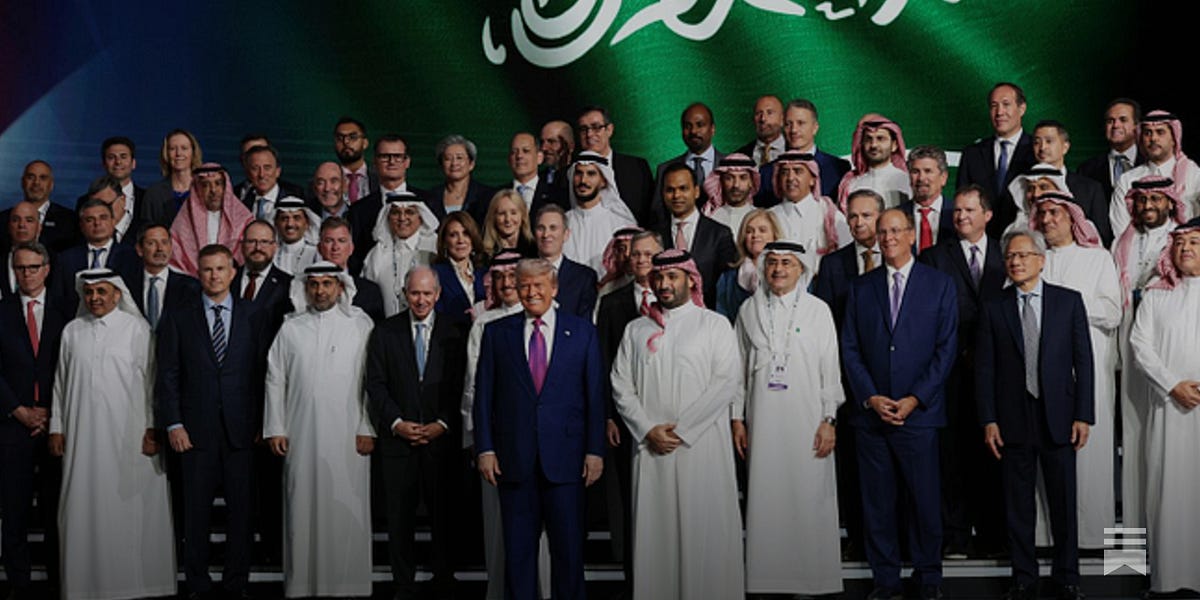
Arab Gulf states face a strategic AI dilemma. The desire to cultivate AI sovereignty means hedging technology partnerships in an increasingly bifurcated global semiconductor competition between U.S. and Chinese ecosystems. The GCC finds itself positioned between two incompatible systems. Aligning with Washington's semiconductor architecture offers access to the world's most advanced AI accelerators but subjects Gulf countries to stringent export controls, technology transfer restrictions, and congressional oversight. The United States builds high fences around its technology to exclude competitors, and partnership comes with expectations of exclusive alignment. Beijing, by contrast, does not demand exclusivity for cooperation in its technology ecosystem and offers politically unconstrained engagement, though this risks technological lag and potential loss of access to U.S. technology.
For Gulf policymakers pursuing AI-driven economic transformation and strategic autonomy, the question is not which side to choose, but how to maintain optionality and maneuverability in both ecosystems without being held hostage or locked out by either. That calculus begins with securing long-term access to chips and the fragile, politically contested supply chains on which they depend.
Overview
AI sovereignty—a nation's capacity to develop, deploy, and control AI systems independent of external political constraints—is a core national security priority for Saudi Arabia and the UAE. The region's AI capabilities are linked to all factors of national development and underpin military effectiveness, economic competitiveness, and state capacity across critical domains. Riyadh and Abu Dhabi are investing billions to build robust domestic AI capabilities, aiming to shield against dependency on foreign platforms for essential government functions and limiting exposure to supply cutoffs during geopolitical crises and vulnerability to external surveillance.
Saudi Arabia has launched its national AI champion, Humaine, and secured major U.S. investment from Microsoft and, critically, U.S. commitments for the delivery of advanced AI chips. The UAE's G42 has similarly attracted significant U.S. backing and enjoys privileged access to high-end semiconductors, positioning it as one of the Middle East's most powerful AI companies. On December 9, Qatar announced the launch of its own $20 billion AI partnership between Qai and Brookfield for the country's growing AI ecosystem. These investments are a good start, but achieving AI sovereignty requires securing the underlying compute infrastructure that makes AI deployment possible at scale. This requires securing a greater foothold in the global supply chain and localizing as much of the ecosystem as possible to the GCC region.
Finding an Access Point
The current semiconductor landscape operates on a fabless-foundry model. Design firms like NVIDIA, AMD, and Qualcomm design chips but outsource all manufacturing to foundries, which produce the actual chips. While there are numerous chip design firms, only a few foundries exist, producing extreme market concentration and key chokepoints. In 2024, the top five chip design houses captured over 90 percent of revenue among the top ten, with NVIDIA alone accounting for roughly half—about $124 billion, driven overwhelmingly by AI GPUs. On the manufacturing side, concentration is even more severe. TSMC holds approximately 70 percent of the advanced foundry market, leaving chip designers like NVIDIA with "no option" but to use TSMC for their most advanced chips.
The result is that access to compute is governed by a fragile sequence of chokepoints: advanced foundry capacity, U.S.- and allied-controlled foundational fabrication tools, and export regulations. Washington has leveraged strategic control of these chokepoints to restrict China's access to U.S. chips and constrain China's AI development. The Biden administration tightened global licensing requirements for access to microchips in what was known as the "small yard, high fence" policy to minimize the potential for diversion. A number of Middle East countries found themselves locked out of the ecosystem due to their investments in Chinese technology, but some found relief after committing to divesting from Chinese tech. Now, Biden is out and the Trump administration has since pivoted on this posture. The White House has since approved sales of advanced chips for the UAE and Saudi Arabia, but these deals may remain contingent upon enforcement of strict security and safeguards to protect U.S. technology.
Simultaneously, U.S. industrial policy is driving a decisive shift in manufacturing location to mitigate geopolitical risk. Under the Biden administration, the CHIPS Act and parallel initiatives in Japan and Europe made significant efforts to insulate the supply chain through subsidies and "friend-shoring," promoting investment among vetted aligned countries. The Trump administration has accelerated this by expanding domestic chip production and construction of new foundries within the United States.
This shift in U.S. and allied industrial policies creates the opening the GCC has been seeking. The Gulf states' drive for AI sovereignty aligns directly with Washington's push to build more secure and geographically diversified compute infrastructure. Saudi Arabia and the UAE will not replicate TSMC-style leading-edge fabs, but they offer what the U.S. ecosystem urgently needs: deep capital reserves, guaranteed low-cost energy for AI data centers, and political stability—core ingredients for de-risking a strained global supply chain. In return, the United States provides what the Gulf seeks most: reliable access to frontier chips and advanced technologies.
The UAE's use of GlobalFoundries illustrates how this alignment works in practice. Through Mubadala's ownership, Abu Dhabi leveraged U.S. incentives for supply-chain localization by committing to a $16 billion expansion of GlobalFoundries' manufacturing capacity in New York and Vermont. This investment locks in long-term access to U.S.-based semiconductor production. The United States gains resilient fabrication capacity onshore, while the UAE secures stable chip supply in a politically secure environment.
Enter China
The paradox for the GCC is that the more it pursues AI sovereignty, the more it must rely on the United States. This alignment comes with expectations of limiting Chinese technological engagement. The question for Arab Gulf states is not "U.S. or China?" but how to build enough redundancy and bargaining power that neither ecosystem can unilaterally dictate the region's AI future. This is where sovereignty is cultivated. It requires maintaining productive engagement with both sides, even as Washington pushes for exclusivity and China pushes for access.
While U.S.-GCC AI cooperation is growing, the GCC still has robust cooperation with Beijing's AI ecosystem. More specifically, China has made significant inroads into the GCC under the banner of the Digital Silk Road, the tech-focused extension of China's Belt and Road Initiative. This presence is largest in the UAE and Saudi Arabia.
The Sino-UAE partnership rests on a series of strategic agreements, memoranda of understanding, and high-level diplomatic engagement that formalize shared objectives and create frameworks for joint projects. Chinese firms including UBTECH Robotics, SenseTime Group (with its EMEA R&D center in Abu Dhabi), Huawei, Hikvision, and Alibaba Cloud have established operations or major agreements in the UAE, building AI labs, smart city platforms, security infrastructure, and cloud services. These collaborations combine technology transfer, infrastructure development, and talent exchange which help embed Chinese AI capabilities into the UAE's digital ecosystem.
Saudi investment in China-linked AI has not matched the UAE's engagement, but Riyadh has taken notable steps to deepen ties with Chinese technology firms as part of a broader strategy of diversified partnerships. In 2024, Saudi Arabia's Prosperity7 Ventures, the venture arm of Saudi Aramco, joined a $400 million financing round for Chinese generative AI firm Zhipu AI, making it one of the few foreign investors in a major Chinese AI startup valued at around $3 billion. The investment, along with a number of new deals announced each year, signals Saudi interest leveraging Chinese AI development to improve its own, even as U.S. scrutiny of such ties has grown.
Which Sovereignty?
The core challenge Gulf policymakers face is that AI sovereignty cannot be achieved through exclusive alignment with either side. If the GCC intends to maintain AI sovereignty, it must balance U.S. expectations with its desire to sustain productive ties to China, its largest trading partner and a significant technology supplier. The GCC's long-term AI capability requires success on two fronts: securing the technological foundations for a robust domestic AI ecosystem and navigating the geopolitical constraints that govern access to it. For the foreseeable future, advancing one dimension will require flexibility on the other. Gulf states will need to reassure Washington that their AI and semiconductor environments remain secure and insulated from Chinese influence, while preserving enough engagement with China to maintain alternatives, retain leverage, and avoid strategic dependence on a single ecosystem.
AI sovereignty in the GCC will be determined by how effectively Gulf states use their position as major purchasers, investors, and hosts of global compute infrastructure to prioritize the U.S. ecosystem without fully distancing Chinese investors.
While Chinese influence in the Gulf remains modest compared to bilateral U.S.–Gulf commitments, Gulf states may see little incentive to fully abandon the Chinese option entirely because Beijing offers them a form of geopolitical insurance should access to U.S. hardware or cloud services tighten. This logic is reinforced by the unpredictability of U.S. politics. Gulf governments may hedge more actively ahead of midterm elections in 2026 or in anticipation of a potential White House shift that could weaken or reverse recent advances in U.S.–GCC technology integration, though this seems to be less likely.
AI sovereignty in the GCC will be determined by how effectively Gulf states use their position as major purchasers, investors, and hosts of global compute infrastructure and cheap energy production to prioritize the U.S. ecosystem without fully distancing Chinese investors. This hedging will be necessary to preserve enough autonomy that, when the next wave of export restrictions arrives, Gulf AI systems remain operational, and their strategic objectives are still achievable.
If China Catches Up
In writing this paper, one glaring issue in my analysis that AI experts in China and the GCC pointed out to me is the overprivileging of the U.S. lead over China in AI technology and chip production. There are many factors and means of evaluating the time gap the U.S. has over China in terms of development. Trump's AI Czar David Sacks says 1.5 years. Others, like former National Security Advisor Jake Sullivan and Deputy National Security Advisor Jon Finer, argued in their podcast "The Long Game" that it could be longer and growing annually.
Perhaps one of the most interesting arguments to date that merits consideration is how Beijing perceives its technology gap with the United States. The GCC decision to choose the U.S. tech ecosystem assumes that near-term gains of alignment will deliver long-term opportunities. But Chinese scholars told me that time is evaluated differently. In the words of one Chinese investor: "China does not measure its success by competition with the West. It measures success by the degree to which it is self-sufficient from the West and reduces reliance on it by scaling its own domestic production."
He underscored that the CHIPS Act showed China that the real prize is localizing the entire AI supply chain and fully decoupling from the U.S. supply chain to ensure that China can produce everything it needs—even during periods of escalation with the U.S.—so that U.S. threats of chip bans are far less lethal than in previous periods.
This reframing matters for Gulf hedging calculations. China need not match TSMC's cutting-edge fabrication or NVIDIA's performance to provide GCC states with meaningful alternatives—it needs only to reach sufficiency thresholds where chips are adequate for most Gulf AI applications, even if not globally competitive. The timeline for "sufficiency" is considerably shorter than the timeline for "parity." A 70-percent-as-capable Chinese chip that comes without U.S. regulatory oversight may prove more valuable to Gulf states than a cutting-edge U.S. chip that requires accepting subordination to U.S. frameworks.
If China reached a point where it could overcome its manufacturing and compute lag behind the U.S. and localize the full chip production value chain, that could create the conditions for GCC countries to seek greater access and cooperation with the Chinese tech ecosystem. I cannot predict how likely this outcome is, but it seems that this may be one of the potential outcomes that GCC countries are creating room for.
This paper is also accessible via Substack at Rocks, Rockets, & Robots.