← Back to Map

Oman's AI Ecosystem

Muscat Oman

Oman's AI ecosystem is best understood as a connectivity play augmented by niche industrial bets—a strategy distinct from any GCC peer. The sultanate hosts 18+ submarine cables, operates the Middle East's first AWS-accredited sovereign cloud through Omantel's Otech platform, and has staked out the most deliberate semiconductor entry strategy in the Gulf.

I. Institutional Architecture

Oman's AI governance centers on the Ministry of Transport, Communications, and Information Technology (MTCIT), which oversees the National Programme for AI and Advanced Digital Technologies—launched in September 2024 as an upgrade to the 2022 Executive Programme. The program runs from 2024 to 2026 and targets raising the digital economy's GDP contribution from 2% (2021) to 5% by 2030 and 10% by 2040, aligned with Oman Vision 2040.

The programme rests on three pillars: integrating AI across key economic sectors; localizing AI technologies through public-private partnerships and R&D infrastructure; and establishing governance and regulatory frameworks for ethical AI use. Key deliverables include a National Open Data Portal (63% complete as of early 2025), a National Center for AI Research and Development, an AI Studio connecting specialists with enterprises, and Oman GPT—a national language model trained on Omani cultural and scientific heritage. The AI language model "Mu'een" was launched at COMEX 2025 as the first operational national AI model, initially deployed across government.

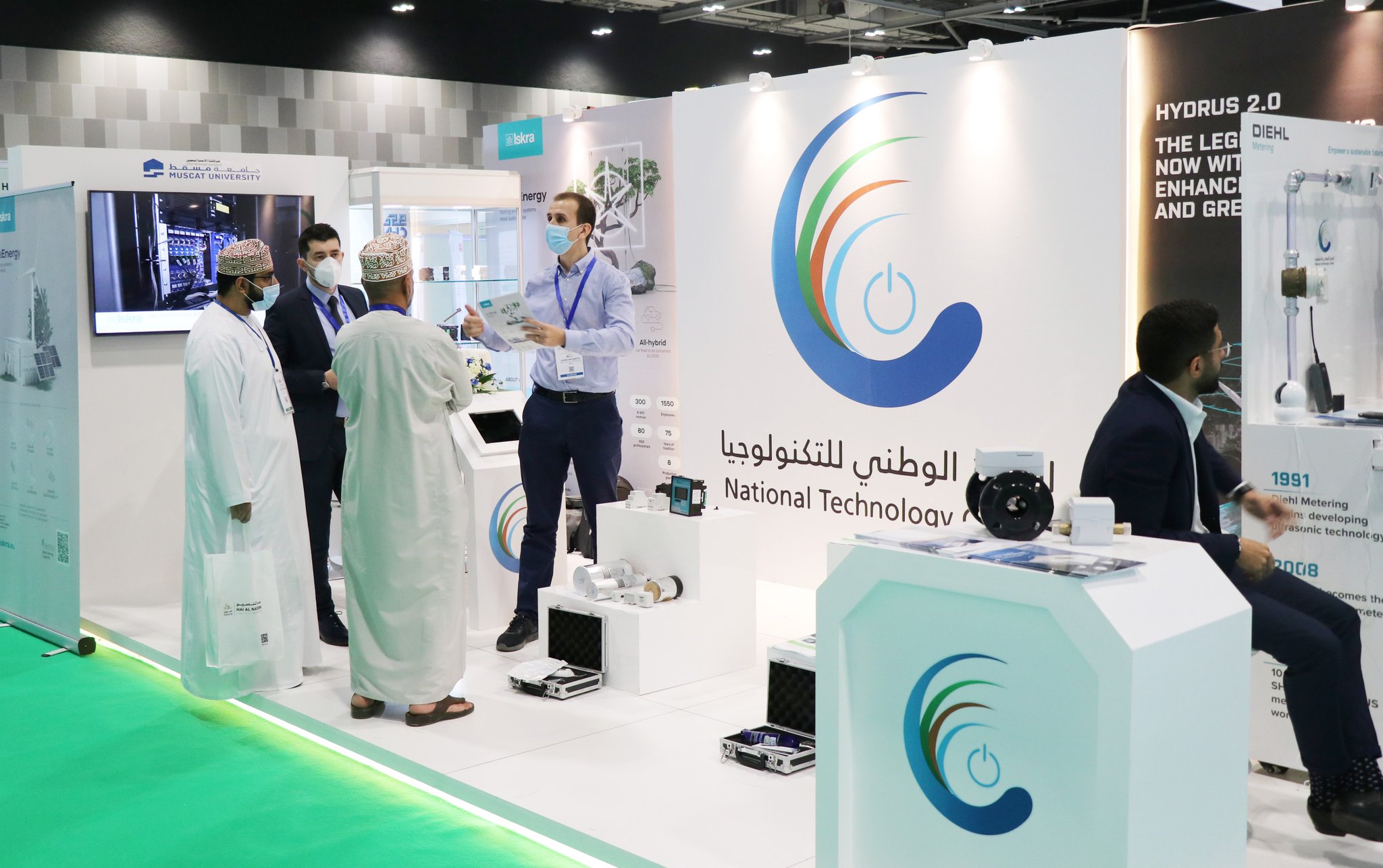
MTCIT also announced at COMEX 2025 (September 2025) three landmark infrastructure projects: the AI Designated Zone in Al Seeb, Muscat Governorate—a specialized free zone for AI startups from Oman, the Middle East, and Africa, managed by OPAZ with global implementers selected through public tender; the Digital Triangle Project—three interconnected digital zones in Barka, Duqm, and Sur forming a regional gateway for cloud, AI, and advanced digital services; and the Green AI Alliance—the region's first sustainability-focused AI initiative uniting government, energy companies, tech firms, and investors around green data centers and clean-energy-powered computing. Agreements worth OMR 42 million ($109M) were signed at COMEX 2025.

The Oman Investment Authority (OIA) functions as the sovereign wealth fund with $53 billion in assets under management, $4.12 billion net profit in 2024, and recognition among the top ten sovereign funds globally by Global SWF for five-year annualized returns. OIA invests through three verticals: the National Development Fund (63% domestic, focused on energy, logistics, mining), the Future Generations Fund (international exposure across AI, healthcare, fintech, energy transition—including 13 new fund stakes in 2024), and Future Fund Oman ($5.2B, launched January 2024, committed $865M to projects including the Sohar polysilicon plant—set to be the world's largest outside China—and joint funds with IDG Capital targeting ICT, renewables, and agritech).

OIA's technology arm is ITHCA Group, which manages semiconductor and deep-tech investments. Oman's revised National AI Policy was released in 2025, establishing governance, data protection, transparency, and accountability standards.

II. U.S. Technology Stack: Otech

Otech: The Sovereign Cloud Platform

In February 2026, Omantel—Oman's state-linked national telecommunications provider—launched Otech, a unified technology platform consolidating Oman Data Park and subsidiary Tedom under a single operational entity. Otech delivers services across data centers, cloud computing, cybersecurity, AI, IoT, and systems integration. The platform holds the distinction of being the first entity in the Middle East accredited by Amazon Web Services to deliver sovereign cloud services. Omantel also inaugurated the Firq Data Centre as Otech's secure, scalable hub for mission-critical operations.

Otech's integrated platform supports workloads across public, hybrid, and hyperscaler environments through partnerships with four major cloud providers: AWS (sovereign cloud accreditation, Cloud Center of Excellence established via March 2024 strategic agreement); Oracle (hyperscale cloud platforms via Oracle Alloy, with Oracle's Dedicated Region Cloud@Customer already operational as Oman's sovereign cloud foundation); Google Cloud (partnership for cloud services); and Huawei (discussed below). Additional Otech partnerships include PwC (cybersecurity and local capability-building), Nagarro (systems integration), Palo Alto Networks/Unit 42, and Fortinet.

Crucially, no U.S. hyperscaler operates a dedicated cloud region inside Oman. Google, Microsoft, and Amazon serve Omani customers through local partners and nearby regions. The December 2022 MTCIT-AWS MoU envisioned joint cloud data service centers, and the AWS-Omantel sovereign cloud agreement advances that agenda—but Oman has not yet secured the kind of dedicated Azure or AWS region that Qatar, Kuwait, and Bahrain have attracted or are building. This gap means advanced generative AI workloads requiring low-latency hyperscale compute face a structural disadvantage.

Data Center Ecosystem

Oman's colocation market comprises approximately six operational facilities operated by Equinix (data centers in Muscat and Salalah), Ooredoo Oman (new data centers in Barka, Salalah with CLS, and Sohar), Oman Data Park (now under Otech, Tier III Duqm facility), Cloud Acropolis, and Datamount. Gulf Data Hub entered the market in 2023 with plans for two facilities.

Ooredoo's August 2025 Salalah Data Centre and Cable Landing Station launched as the first facility in southern Oman combining a Tier III-quality data center with a submarine cable landing station. Starting at 125 racks and scaling to 500, it serves as a southern gateway connecting Asia, Europe, and Africa. The data center market is projected to reach $326 million in investment by 2029, growing at a CAGR of 10.3%.

III. Chinese Technology Stack

Huawei's presence in Oman runs deeper than in most GCC peers. Omantel chose Huawei as its national cloud infrastructure partner, citing the company's proven expertise in building national cloud infrastructure and global experience with AI, big data, and machine learning. As Omantel's chief business strategist told Huawei's own media in November 2024: the cloud being built "will serve as a backbone for digital transformation in Oman." This makes Huawei a foundational layer of Oman's sovereign digital infrastructure—not merely a telecom equipment vendor.

Huawei's integration extends across sectors. Oman Airports partnered with Huawei beginning in 2022 to deploy the world's first full-scenario Wi-Fi 7 airport network (May 2024) and a comprehensive intelligent campus security system (June 2025). In February 2023, Ooredoo Oman collaborated with Huawei to implement 5G technologies, wireless solutions, and next-generation services. Omantel's Otech platform lists Huawei alongside AWS, Oracle, and Google Cloud as a strategic cloud partner—meaning Huawei Cloud coexists with American hyperscalers inside Oman's sovereign cloud ecosystem. This dual-stack architecture parallels Qatar's Huawei Cloud-MEEZA arrangement but operates through Oman's national telecom operator rather than a separate data center company.

Assessment: Oman's Chinese technology exposure is deeper than Kuwait's (where Huawei runs through Zain's telecom partnership) and comparable to Qatar's. The Omantel-Huawei cloud partnership embeds Chinese infrastructure into the very backbone that MTCIT wants to connect 120+ government entities to. For Oman, this represents pragmatic diversification—leveraging multiple global technology stacks to avoid single-vendor dependency. For Washington, it raises the same dual-stack compliance questions that apply to Qatar, though Oman's smaller scale and lower profile have attracted less scrutiny.

IV. Connectivity Corridor: Oman's Distinctive Asset

Oman's most underappreciated strategic asset is its position as a submarine cable supernode. The sultanate hosts 18+ undersea internet cables with six cable landing stations, providing low-latency global connectivity that links the Middle East, Asia, Europe, and Africa. This makes Oman one of the most connected countries in the region by physical infrastructure—a structural advantage that no amount of capital can quickly replicate.

Key cable systems include: the 2Africa mega-cable (27,500+ miles, landing at Barka and Salalah via Ooredoo partnership); Google and Sparkle's Blue-Raman system (8,000 km, connecting Europe to India via Oman); the Oman Australia Cable (OAC) operated by SUBCO, with a Salalah Gateway extension making Oman a bridge between the Indian Ocean and Middle East; Ooredoo's Fibre in Gulf (FIG) submarine cable connecting all GCC states plus Iraq (up to 720 Tbps capacity); and the SONIC terrestrial fiber corridor linking Oman directly to Saudi Arabia.

Nokia and Ooredoo Oman are collaborating to deploy a dense wavelength division multiplexing (DWDM) wholesale network for hyperscalers and AI applications, scheduled for commercial launch in 2025. This positions Oman as a connectivity center between Europe, the Gulf, and the Indian Ocean.

The connectivity thesis links directly to the Digital Triangle Project (Barka-Duqm-Sur): three coastal hubs located at strategic submarine cable landing points, each paired with green data centers and fiber optic backhaul. Oman's play is to become the physical layer beneath the GCC's digital economy—the transit point where data crosses between continents—rather than competing head-to-head with Abu Dhabi or Riyadh on compute scale.

V. Semiconductor Strategy and Energy Niche

Semiconductor Ecosystem

Oman has staked out the most deliberate semiconductor entry strategy in the GCC. In 2022, MTCIT and the Ministry of Labour signed a cooperation agreement with GS Micro Electronics (GSME)—a U.S.-based semiconductor design firm—to establish Oman's first chip design and manufacturing training center. GSME-Oman, backed by OIA subsidiary ITHCA Group, became the GCC's first semiconductor design and training company. Six months of testing produced two chips: Oman 1 and Oman 2—a milestone for any Gulf state.

In May 2025, ITHCA Group invested in Lumotive, a Washington state-based firm pioneering programmable optical semiconductor technology for LiDAR sensors. This led to a partnership with GSME to create a LiDAR design center in Muscat, and Lumotive subsequently opened offices in Oman. In October 2025, ITHCA invested $20 million in Movandi, a U.S. semiconductor and wireless connectivity firm, which will establish a Muscat R&D hub for smart communications and AI.

Additionally, Kaynes Semicon (subsidiary of India's Kaynes Technology) partnered with local stakeholders to establish a VLSI design center in Muscat. Invest Oman is actively inviting international OSAT (outsourced semiconductor assembly and test) companies to set up operations, with an estimated $130–140M investment and $110M in capex. OIA also signed a memorandum with Japan for a second national semiconductor investment and explored cooperation with South Korea's SK Hynix in October 2023.

Oman hosted the first Middle East edition of the International Semiconductors Executive Summit (ISES) in February 2023. The Sohar polysilicon plant (backed by FFO/GSME) will be the world's largest outside China—positioning Oman in the upstream materials supply chain rather than competing on chip fabrication.

Green Hydrogen and Renewable Energy

Oman's green hydrogen programme is the most ambitious in the GCC relative to national GDP. Hydrom (Hydrogen Development Oman), launched in 2022 under royal directive, manages the sector. Oman has earmarked approximately 50,000 km² of land—primarily in high-wind and high-solar regions—with targets to produce 1M tons of green hydrogen per year by 2030 and 25M tons by 2050, requiring up to 180 GW of renewable capacity. Projects include: HyPort Duqm (OQ/DEME, 1.3 GW Phase 1, BP acquired a 49% stake in July 2025); Green Energy Oman (4–25 GW); POSCO-ENGIE (5 GW, 200K tons green hydrogen/year); Actis-Fortescue (4.5 GW); and EDF-J-POWER-Yamna (4.5 GW). Hydrom launched its third green hydrogen auction round in April 2025.

The green energy-AI nexus operates through the Green AI Alliance announced at COMEX 2025: green data centers powered by renewable energy, efficiency optimization for large language models, and clean energy solutions for high-performance computing. Oman's National Energy Strategy targets 30% electricity from renewables by 2030. Where Qatar's petro-compute thesis sells LNG to power global data centers, Oman's emerging thesis links green hydrogen production to clean-powered data center operations.

VI. Export Control Navigation

Under the Biden AI Diffusion Rule (January 2025), Oman was classified in Tier 2 alongside all GCC neighbors—facing caps on advanced GPU imports. The Trump administration rescinded the rule in May 2025, replacing it with bilateral deal-making and stronger enforcement against Chinese diversion.

Oman's export control position presents a mixed picture. On one hand, OIA's investment in xAI (December 2024) and SpaceX (earning 37%+ IRR), combined with ITHCA's semiconductor investments in U.S. firms (GSME, Lumotive, Movandi), signal strong commercial alignment with American technology companies. On the other hand, Omantel's selection of Huawei as a national cloud infrastructure partner—embedding Huawei Cloud inside the Otech sovereign platform alongside AWS and Oracle—creates the same dual-stack compliance complexity that Washington watches in Qatar and the UAE.

Oman benefits from lower visibility: its AI ambitions are more modest than Saudi Arabia's or the UAE's, it has not accumulated massive GPU stockpiles, and its data center footprint remains small. But the Huawei cloud integration is structural, not peripheral. Oman's semiconductor OSAT ambitions add a separate dimension: if the sultanate succeeds in attracting international OSAT companies and scaling chip design through GSME and Kaynes Semicon, it will need clarity on which semiconductor technologies it can receive, process, and re-export.

VII. Comparative Positioning

Dimension Saudi Arabia UAE Qatar Kuwait Bahrain Oman
National AI VehicleHUMAIN (PIF, full-stack, GW-scale)G42 + MGX ($100B fund) + AIATC + MBZUAIQIA + TASMU Smart QatarCAIT + KNDPiGA + TamkeenMTCIT + Oman GPT
GPU Commitments600K+ NVIDIA + AMD JV (1 GW)5 GW Stargate UAE campus; 35K chips approved; GB300 GPUs~Moderate~Nascent~Nascent~Nascent
Hyperscaler RegionsAWS (2026), Google, Oracle ×2, MicrosoftMicrosoft ($15.2B), AWS, Oracle, Google; Khazna 70% DC marketGoogle, Microsoft, AWSMicrosoft Azure pilotAWS (2019)Otech multi-vendor
Chinese Stack DepthDeep: Huawei ×4, Alibaba, Tencent, China Mobile JVDivested: G42 stripped Huawei/ByteDance; Lunate retains 42X stakesHuawei core networkLimitedLimitedDeep: Huawei national cloud
Semiconductor PlayAlat ($100B), NSH, KACST 3,600m² cleanroomGlobalFoundries (world #3, Mubadala); MGX in Altera chip designNoneNoneNoneGSME (Oman 1/2 chips), OSAT pipeline
Energy for ComputeVirtually unlimited; 50% renewables 2030Barakah nuclear 5.6 GW + 5 GW solar; surplus to 2035Abundant gasAbundant but constrained gridLimitedGreen hydrogen + renewables
SWF (AUM)$913B (PIF)$1.7T+ Abu Dhabi (ADIA $1.18T, Mubadala $358B, ADQ $251B)$510B (QIA)$923B (KIA)$18B (Mumtalakat)$53B (OIA)
Export ControlTier 2 (rescinded); 35K chips approved Nov 2025Tier 2 (rescinded); 35K chips approved Nov 2025; Regulated Tech Env.Tier 2 (rescinded)Tier 2 (rescinded)Tier 2 (rescinded)Tier 2 (rescinded)

VIII. Assessment and Strategic Outlook

Oman's AI ecosystem is best understood as a connectivity play augmented by niche industrial bets—a strategy distinct from any GCC peer. The sultanate cannot match Qatar's sovereign wealth ($557B vs. $53B), Saudi Arabia's compute ambitions, the UAE's model-development ecosystem, or even Kuwait's raw financial firepower ($1T). What Oman possesses is geography, cables, and institutional patience.

The connectivity corridor thesis is real. Eighteen-plus submarine cables, six landing stations, the Salalah-Barka-Duqm triangle, and the DWDM wholesale network being built with Nokia create physical infrastructure that is expensive, slow to replicate, and increasingly valuable as global data traffic surges. The Digital Triangle Project formalizes this into a national strategy: coastal hubs at cable landing points, paired with green data centers, designed to attract hyperscalers and content delivery networks. If executed, Oman becomes the Indian Ocean's digital transit point—routing traffic between Asia, Africa, and Europe through sovereign-controlled infrastructure.

Otech changes the sovereign cloud calculus. By consolidating Oman Data Park, Firq Data Centre, and partnerships with AWS, Oracle, Google Cloud, and Huawei under a single platform—with the Middle East's first AWS sovereign cloud accreditation—Omantel has created what no other GCC operator outside the UAE's du has assembled: a genuinely multi-vendor sovereign cloud. The risk is complexity; the opportunity is avoiding lock-in to any single technology stack.

The semiconductor entry is the sleeper bet. No other Gulf state has produced domestically designed chips. Oman 1 and Oman 2 are proof-of-concept, not commercial products—but the GSME training center, Lumotive's LiDAR design hub, Movandi's RF chipset R&D office, Kaynes Semicon's VLSI center, and the OSAT investment pipeline ($130–140M) represent the most sequenced semiconductor strategy in the region. The Sohar polysilicon plant adds upstream material supply.

Green hydrogen is the long-duration energy play. Oman's 50,000 km² of allocated land, 180 GW of potential renewable capacity, and Hydrom's managed auction process have attracted BP, POSCO, Fortescue, EDF, and ACME. If the Green AI Alliance delivers on its vision of clean-energy-powered data centers, Oman could offer hyperscalers something no GCC neighbor currently provides: AI compute powered verifiably by renewable energy.

For external stakeholders: Oman is connectivity partner, semiconductor niche player, and green-energy AI host—not compute sovereign. Firms seeking to route data between Asia, Europe, and Africa through sovereign-controlled infrastructure will find Oman compelling. Semiconductor companies seeking a GCC design and OSAT base with government backing should evaluate the Muscat ecosystem. AI companies needing clean-energy-powered infrastructure should track the Digital Triangle's development. Firms requiring hyperscale compute, frontier model deployment, or massive GPU clusters will look to Abu Dhabi, Doha, or Riyadh.

Oman's strategic challenge: convert geographic advantage into economic capture. Cables crossing Omani waters generate transit revenue only if traffic lands and processes locally. Data centers attract tenants only if power, connectivity, and regulatory environment all align. The Green AI Alliance, AI Designated Zone, and Digital Triangle are the right conceptual pieces—but they remain at announcement stage. Execution will determine whether Oman becomes the GCC's indispensable digital corridor or simply a well-connected country that data passes through.