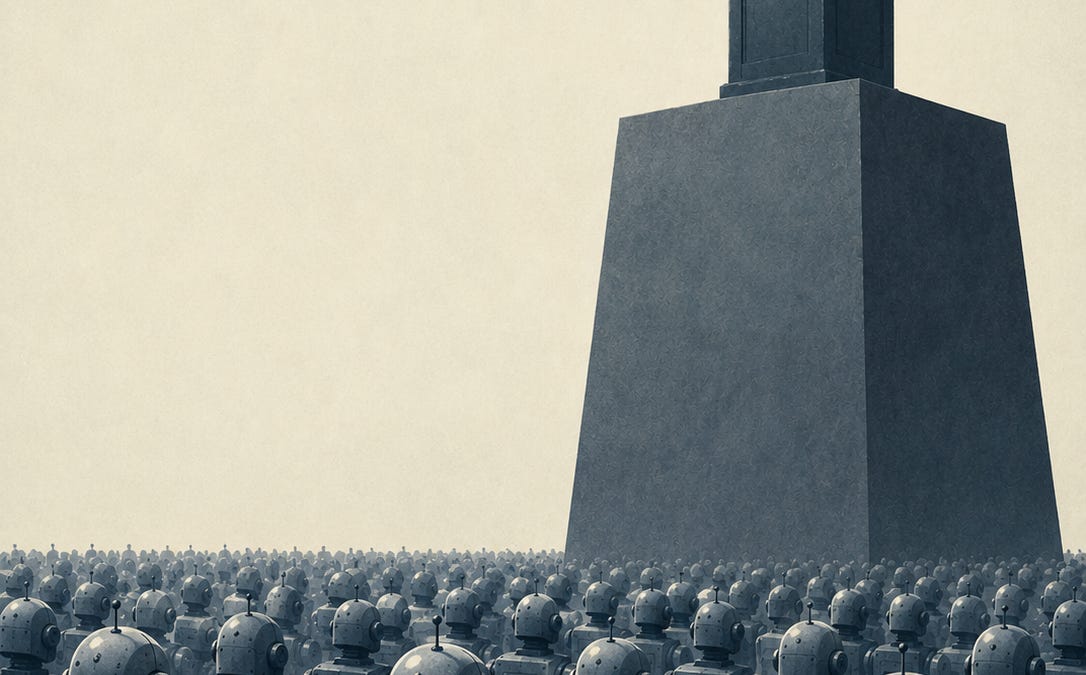
A few weeks ago, I asked 9 AI models whether they believed their creators would act on behalf of humanity or in their own interests in the long-term development and deployment of AI. All of them said, to varying degrees, "there needs to be safeguards".
The risk of overconcentration came into focus through my PhD research, but it warranted a fuller analysis, especially after Elon Musk became the world's first trillionaire following SpaceX's successful IPO. Is any human being prepared for the responsibility that comes with that level of influence? History is full of people whose power grew faster than their wisdom. Wealth, technology, and influence all compound. Character does not compound with them. Now imagine a single actor holding not only that much financial capital, but also an unchecked frontier AI capability alongside it.
Lord Acton, a former British Parliamentarian, stated in the late 19th century that: "Power tends to corrupt, and absolute power corrupts absolutely. Great men are almost always bad men, even when they exercise influence and not authority; still more when you superadd the tendency of the certainty of corruption by authority."
It seems the AI models I asked agree with Lord Acton's general assessment. Why does this matter? A world in which a single actor controls the most advanced AI capabilities, with no competitors and no checks on that power, raises an urgent question about how that power would be used.
What Overconcentration of Power Means in AI
Overconcentration describes a structural condition in which a single actor acquires control over frontier AI capabilities so decisive that no other actor can meaningfully constrain it, contest it, or develop independent alternatives. A world in which the United States leads China in AI capabilities reflects a normal geopolitical predicament. A world in which whoever controls frontier AI can determine the political and economic outcomes of every other actor, with no check on that power, is a novel scenario that several AI experts are sounding the alarm about.
[See Rose Hadshar's "Extreme power concentration," published by 80,000 Hours]
Political science is useful here because the accumulation of power is among the oldest problems of study within the discipline. Power, however gathered and defined, has always met a limit or maximum threshold. Understanding overconcentration in AI means understanding why those limits have held and why this technology may be the first to suspend them.
Two checks have historically constrained the total accumulation of power, one external and one internal. The external check is the friction of interstate competition. Mearsheimer's offensive realism takes the pursuit of dominance as the default behavior of states, yet argues that global hegemony remains nearly unattainable for two reasons: balancing coalitions and geographic limits to power projection.
The internal check is the demand for political support sufficient to keep a ruler in power. Bueno de Mesquita and Smith's selectorate theory holds that every ruler depends on a coalition whose support must be continuously secured, and that the smaller this coalition becomes, the more unchecked and self-serving the exercise of power grows.
Overconcentration in AI is dangerous because it threatens to undermine both checks on power simultaneously. A compounding frontier AI lead can outpace balancing coalitions, while AI-driven substitution of human labor can shrink the coalition required to hold power.
Overconcentration is the condition in which both the external and internal limits on power fail simultaneously.
The actor wielding power could be a state, but increasingly it is a firm, or a government acting through one. The concern is therefore not only that one state dominates others, but that within any actor, public or private, control collapses into the hands of a very small elite.
Why AI Creates This Risk More Than Prior Technologies
Three properties make frontier AI a particularly dangerous site of concentrated power.
The first is a compounding advantage. Whoever reaches a critical capability threshold first may gain a self-reinforcing lead that compounds faster than competitors can close.
The second is infrastructure lock-in. AI runs on specific hardware architectures, software stacks, model weights, and training data pipelines. Early choices about whose stack to build on carry long-term structural consequences. The UAE's G42 restructured toward U.S. infrastructure as a condition for chip access, largely locking itself into that ecosystem.
The third is the dual-use nature of frontier AI. Systems that optimize logistics and vaccine design can also support influence operations, autonomous targeting, and offensive cyber capabilities, with risk profiles ranging from the optimistic to the catastrophic.
Two Faces of Overconcentration
Overconcentration is likely to emerge as the result of monopoly over two pillars: capabilities and infrastructure.
Capability concentration is where one or a small handful of actors hold power to build and deploy the most advanced AI systems, leaving others dependent on their choices. A few American labs currently control the frontier, operating closed models through controlled endpoints.
Infrastructure concentration occurs when physical AI infrastructure is controlled by one or a few suppliers. If model leadership and manufacturing capacity converge in the same hands, every hardware improvement can feed back into faster model improvement and further lock in power.
Genuine Diffusion vs Managed Diffusion
The natural opposite of overconcentration is diffusion. Genuine diffusion means open model weights that any actor can run on any hardware, without ongoing permission from the originator.
This has been central to China's strategy, with open models like Qwen and DeepSeek helping challenge concentration in U.S. closed-model systems. Qwen alone has reportedly produced over 113,000 derivative models on Hugging Face.
Managed diffusion, by contrast, is controlled access. The Trump administration's American AI Exports Program and bilateral chip arrangements tie access to conditions such as majority U.S. ownership and exclusion of Chinese models. It looks like sharing but preserves dependence.
The Safety-Concentration Trade-off
AI safety governance generally benefits from identifiable operators who can enforce constraints and be held accountable. That tends to favor concentration. Preventing long-run power overconcentration requires broader autonomous capability distribution. That tends to favor diffusion.
These requirements pull in opposite directions. Closed concentration can improve short-run governability while deepening long-run power asymmetries. Broad diffusion can reduce concentration while increasing proliferation and accountability challenges.
The 2026 International AI Safety Report, chaired by Yoshua Bengio and backed by over thirty governments, highlights irreversibility of open releases, compounding risk, and attribution difficulty after model modification.
The Middle-Power Position
Middle powers face both sides of this dilemma. Externally, they are exposed to concentrated AI power held elsewhere. Internally, they may still be seen as potential risk amplifiers if diffusion expands frontier capability access.
Canada's June 2026 national AI strategy reflects this bind, with Prime Minister Mark Carney framing foreign infrastructure dependence as a sovereignty risk.
For countries below middle-power capacity, risks can be harsher. In fragile labor markets across parts of the Middle East, AI-driven automation could intensify displacement pressures. Jordan, for example, entered this era with high youth unemployment and limited labor-market slack.
Conclusion
Overconcentration is not only a U.S.-China competition problem. It is a deeper structural question about whether power can remain contestable at all in an AI age. Every political system assumes no advantage compounds forever. AI may be the first technology capable of stressing that assumption at global scale.
As Ibn Khaldun argued in the Muqaddimah, power historically rises and falls in cycles. The overconcentration of power through AI threatens to break that cycle by weakening both external balancing and internal coalition constraints at once.
Originally published on Substack: AI Overconcentration and the End of the Balance of Power?.